Closure talk: « The Sun Up-Close », by Frédéric Auchère
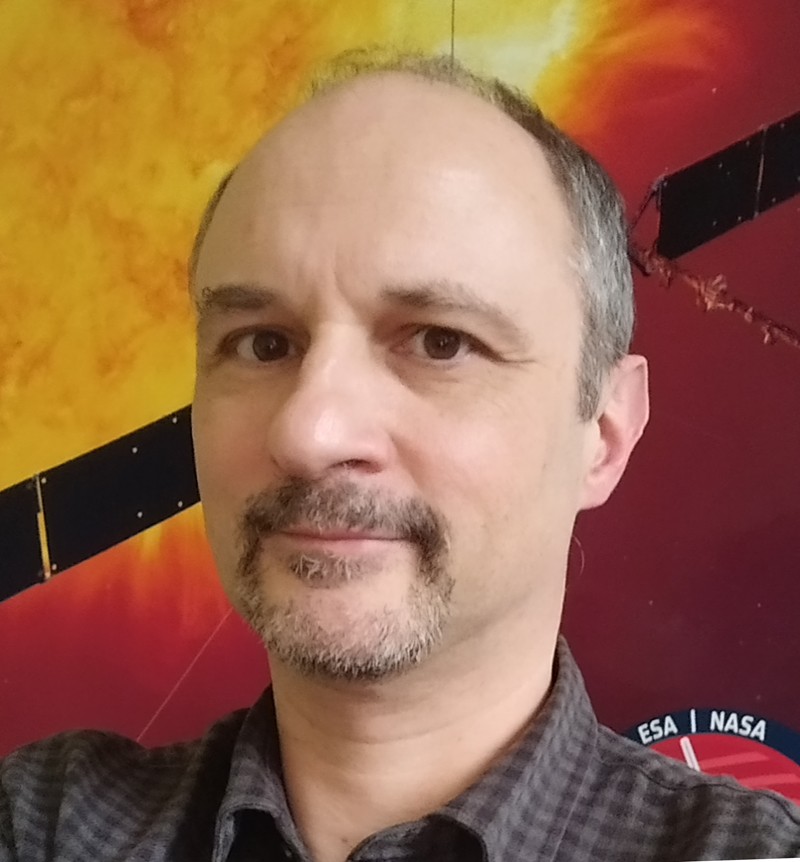
Dr. Frédéric Auchère’s main research interests are the physics of the corona and the solar wind. After completing his PhD at NASA’s Goddard Space Flight Center, and postdoctoral fellowships in the United States and in France, Auchère rose to lead key roles in European solar missions. He is currently PI and co-PI of respectively the SPICE and EUI instruments on board ESA’s Solar Orbiter spacecraft. He is actively involved in the development of the next generation of space solar instruments.
Abstract:
The ESA/NASA Solar Orbiter mission, launched in February 2020, continues to deliver unprecedented high-resolution observations of the Sun and its dynamic atmosphere. This presentation highlights recent findings from two of Solar Orbiter’s key remote sensing instruments: the Extreme Ultraviolet Imager (EUI) and the Spectral Imaging of the Coronal Environment (SPICE).
EUI provides high-cadence, high-resolution imaging of the solar atmosphere in extreme ultraviolet wavelengths, capturing fine-scale structures such as coronal bright points, nano jets, and small-scale eruptions with exceptional clarity.
Complementing EUI, SPICE offers spectrally resolved data across a range of emission lines formed at different temperatures, enabling the measurement of plasma velocities and composition from the chromosphere to the corona.
In particular, coordinated observations between EUI and SPICE have allowed the identification and characterization of transition region upflows and their connection to overlying coronal structures. These findings are further contextualized with magnetic field extrapolations and comparisons with in situ data during close perihelion passages.
Invited talk: « Recent progress in the development of CdZnTe detectors for room temperature X-ray and gamma ray detection », by Leonardo Abbene
Leonardo Abbene is Associate Professor in Applied Physics at the Department of Physics and Chemistry Emilio Segrè at University of Palermo, Italy. He earned a Master’s degree from University of Palermo and a doctorate in Experimental Physics from the University of Bari, Italy. His research activities are mainly focused on the development and characterization of room temperature semiconductor radiation detectors (CdTe, CZT) and digital electronics for X-ray and gamma ray spectroscopy and imaging. He was the principal investigator (PI) of several research projects, where innovative instrumentation has been developed for medical (mammography, computed tomography, BNCT, nuclear medicine), astrophysical (focal plane detectors for X-ray telescopes), food and nuclear (kaonic atom physics) applications. He is author and co-author of over 100 research papers in international journals and conferences. Prof. Abbene is reviewer and editorial board member for several international journals.
Abstract:
In the last two decades, great efforts have been made in the development of new-generation X-ray and gamma ray detection systems based on room temperature semiconductor detectors (RTSDs), allowing direct radiation detection and superb room temperature performance. Among RTSDs, cadmium zinc telluride (CdZnTe or CZT) represents the leading detector material: the combination of high atomic number (Zmax = 52) and wide bandgap (1.6 eV), together with the continuous progress in crystal growth and device technology, gives high detection efficiency within few millimetres and excellent room-temperature energy resolution. The current state of art in developing CdZnTe detectors will be presented, with particular focusing on new CdZnTe-based detection systems, recently developed at University of Palermo (Italy). Several detector prototypes will be presented, designed for applications in nuclear medicine, food inspections and precision X-ray measurements in accelerator environments.

Invited talk: « Timepix: Two Decades of Innovation in Science and Technology », by Eliska Soharova
Since 2024, my role at ADVACAM s.r.o. has been focused on leading and coordinating scientific research and development activities as the Head of the Research Department. Prior to this position, I worked for many years as an Imaging Specialist and Project Manager, gaining extensive experience in advanced spectral imaging technologies and biomedical applications. My professional focus includes hybrid pixel detectors, preclinical and clinical imaging systems, and the development of innovative imaging methods for scientific and medical use. Close collaboration with international research institutions and industrial partners forms an important part of my work. Over the years, I have contributed to several scientific publications in international peer-reviewed journals focused on Timepix detector technologies and advanced imaging methods. My academic background includes a degree in Instruments and Methods for Biomedicine from the Czech Technical University in Prague, while my current doctoral studies at the First Faculty of Medicine, Charles University are focused on Imaging Methods in Medicine.
Abstract:
The contribution outlines the development of pixel detectors from the establishment of the Medipix collaboration at CERN to the current Timepix technologies, which have significantly influenced numerous scientific and technological fields over the past two decades. It focuses on the key stages in the evolution of the Medipix, Timepix, Timepix3, and Timepix4 chips and their gradual transition from experimental high-energy physics to a broad range of practical applications. The presentation introduces the principles of pixel detection enabling precise measurement of individual particles, energy deposition, and timing information with high spatial resolution. Particular attention will be devoted to applications in medical imaging, dosimetry, space research, electron microscopy, material analysis, and radiation monitoring in challenging environments. The contribution will also highlight examples of successful technology transfer from academia to the commercial sector and the emergence of new industrial applications based on pixel detector technologies. The final part will discuss future directions of pixel detectors, including their integration with high-speed data processing, artificial intelligence, and their potential for next-generation scientific experiments and advanced industrial applications.

Invited talk: « The Evolution of Photon Detection across Physics and Medicine: What Could Next-Generation Silicon Photomultipliers Look Like and What Challenges Lie Ahead? », by Stefan Gundacker
Stefan Gundacker is working on developing detectors for positron emission tomography (PET) and high-energy physics (HEP) with a focus on scintillators, photodetectors, silicon detectors, and electronics. He completed his doctoral thesis at CERN (the European Organization for Nuclear Research) in Geneva and at the Vienna University of Technology (TU Wien). Following a postdoctoral fellowship at CERN, he moved to the University Hospital RWTH Aachen, where he led a research group working on time-of-flight PET and the transfer of ultra-precise timing detector concepts to PET systems. Currently he is based at the Marietta Blau Institute for Particle Physics (MBI) of the Austrian Academy of Sciences in Vienna, researching on silicon and silicon-carbide detectors, as well as SiPMs for their use in HEP and medical applications.
Abstract:
Advanced photon detection is a critical capability across various domains, including high-energy and fundamental physics, industrial automation, and medicine. Single-optical-photon sensitivity imaging technologies have become well-established in applications such as automotive light detection and ranging (LiDAR), quantum computing and advanced clinical imaging. Over the past two decades, continuous advancements in silicon photomultiplier (SiPM) technology, specifically regarding photon detection efficiency (PDE), UV and IR sensitivity, single-photon time resolution (SPTR) and noise reduction, have positioned the SiPM as a primary choice for low-light detection, enabling exceptional photon counting and timing performance. Beyond direct light detection, coupling inorganic scintillators to SiPMs extends this functionality to high-energy physics and medical diagnostics. This configuration allows for the efficient detection of gamma and X-ray photons in positron emission tomography (PET) and computed tomography (CT), as well as minimum ionizing particles in accelerator experiments.
Currently, the field appears to be entering a new phase of development, with research increasingly exploring the 2.5D and 3D integration of sensing layers with readout electronics and digitization. This approach could allow for high-density integration in medical detectors, while potentially opening the door to new areas in quantum computing and communication. Furthermore, as applications emerge in extreme environments, such as fusion research, high energy physics and space exploration, the physical limitations of standard silicon are being actively questioned. Consequently, investigation is beginning to expand toward alternative wide-bandgap materials, such as silicon carbide (SiC). This presentation will review past achievements, examine ongoing technological shifts, and discuss what these next-generation designs might look like while outlining the open challenges that lie ahead.